Fast Fashion Makes Trends Available to a Mass Audience. Who Is Responsible?
Clothing · Velvet Andry · November 1, 2026 · 5 min read
Introduction
Fast fashion didn't just make clothes cheaper. It changed what clothing means to us.
Over the last 30 years, fashion went from two main seasons to a constant stream of newness — and from clothes designed to be worn to clothes designed to be replaced.
In this article, we'll look at how fast fashion started, what changed the way we produce and buy clothes, and how that transformation turned clothing from a practical necessity into a growing environmental problem.
Because the story isn't only about what we buy.
It's about how much we make, how quickly we replace it, and what happens when all those clothes eventually leave our wardrobes.
FROM TWO SEASONS TO 52
There was a time when fashion moved in seasons.
Spring/Summer.
Autumn/Winter.
Designers created collections. Stores bought them. You bought something you liked. You wore it for years.
Then fashion discovered a faster business model.
And it started with a surprisingly simple idea: take the looks people wanted from high fashion, make them much cheaper, and get them into stores quickly.
In the 1990s, Zara became one of the companies that established this fast fashion business model at scale. [1]
The formula was simple: watch what was happening in high fashion, translate those trends into Zara's own designs, manufacture them quickly and sell them at a fraction of the price.
Zara was bringing new shipments into stores twice a week. [1] The model worked because the price was lower — but that also meant the company needed a much larger audience buying much more frequently.
And other companies followed.
H&M. Forever 21. Primark. And many others adopted versions of the same strategy, eventually moving from weekly to daily new-product introductions.
The traditional fashion calendar started to collapse.
2 seasons → 24 collections → 52 "microseasons"
Fashion wasn't just getting faster.
Fashion was learning how to sell more.
Within the first 15 years of the 21st century, clothing production doubled. [2]
And that is where the environmental impact of fast fashion starts to become much bigger than the price tag on a dress.
THE ENVIRONMENTAL IMPACT OF FAST FASHION ISN'T JUST ABOUT YOUR POLYESTER T-SHIRT
This is where the sustainability conversation often gets uncomfortable.
We are told to look at the label.
Cotton or polyester?
Organic or conventional?
Natural fibers or synthetics?
Did you buy second-hand?
Those things matter. Materials have environmental consequences.
But there is a bigger question hiding behind the fiber label:
How much clothing are we producing in the first place?
Because a slightly "better" material doesn't solve a system that keeps producing more clothes than people need.
Between 2003 and 2018, clothing utilization fell by 36% — meaning garments were being used for shorter periods. [3]
That is the real shift.
A garment used to be something you owned.
Now, increasingly, it can become something you consume.
Wear it.
Photograph it.
Get bored of it.
Replace it.
The problem isn't that someone bought one polyester sweater.
The problem is fast fashion overproduction: a business model that can make millions of sweaters before anyone knows whether millions of sweaters are actually needed.
BUT WHAT HAPPENS TO OUR CLOTHES AFTER WE WEAR THEM?
Every piece of clothing eventually leaves our wardrobe.
We donate it, pass it on, put it in a collection bin — or throw it away when it’s no longer wearable.
But leaving your wardrobe is only the beginning of its journey.
A donated garment might be resold locally. It might be sorted and recycled or downcycled. Or it might be exported to a second-hand market somewhere else in the world.
In Ghana, for example, around 20 million second-hand garments arrive at Accra’s Kantamanto market every week. Not all of them find a new owner. Around 40% are rejected because they are too damaged or poor quality to sell. [3][4]
From there, some may be reused or recycled. Others can end up dumped, burned or washed into waterways. [4]
The journey doesn’t end when a garment leaves our hands. It simply moves somewhere else.
And that raises a bigger question:
Why are we producing so much clothing that there is more of it than the world can reuse?
SO WHO IS ACTUALLY RESPONSIBLE?
This is where I think we need to stop turning sustainability into a morality test for individual shoppers.
If you can afford a €300 coat made from carefully sourced natural fibers, great.
But what about someone who needs a €30 coat?
Are we really going to tell that person that the environmental crisis is their fault because they couldn't afford the "right" fabric?
That framing misses the scale of the problem.
The fashion industry is an industrial system.
It involves raw materials, factories, energy, chemical processing, transportation, retailers, marketing, inventory and waste — operating at enormous scale.
And the research reviewed in the paper makes an important point: an evaluation of 29 major brands found that voluntary commitments were insufficient to slow the growth of textile volumes. The authors argue that broader laws and regulation are necessary to change the trajectory. [3][5]
That doesn't mean consumers have no power.
We do.
Buying less, keeping clothes longer, repairing them, buying second-hand and choosing better-made pieces can all matter.
But there is a difference between having influence and being responsible for fixing the entire system.
You cannot shop your way out of overproduction.
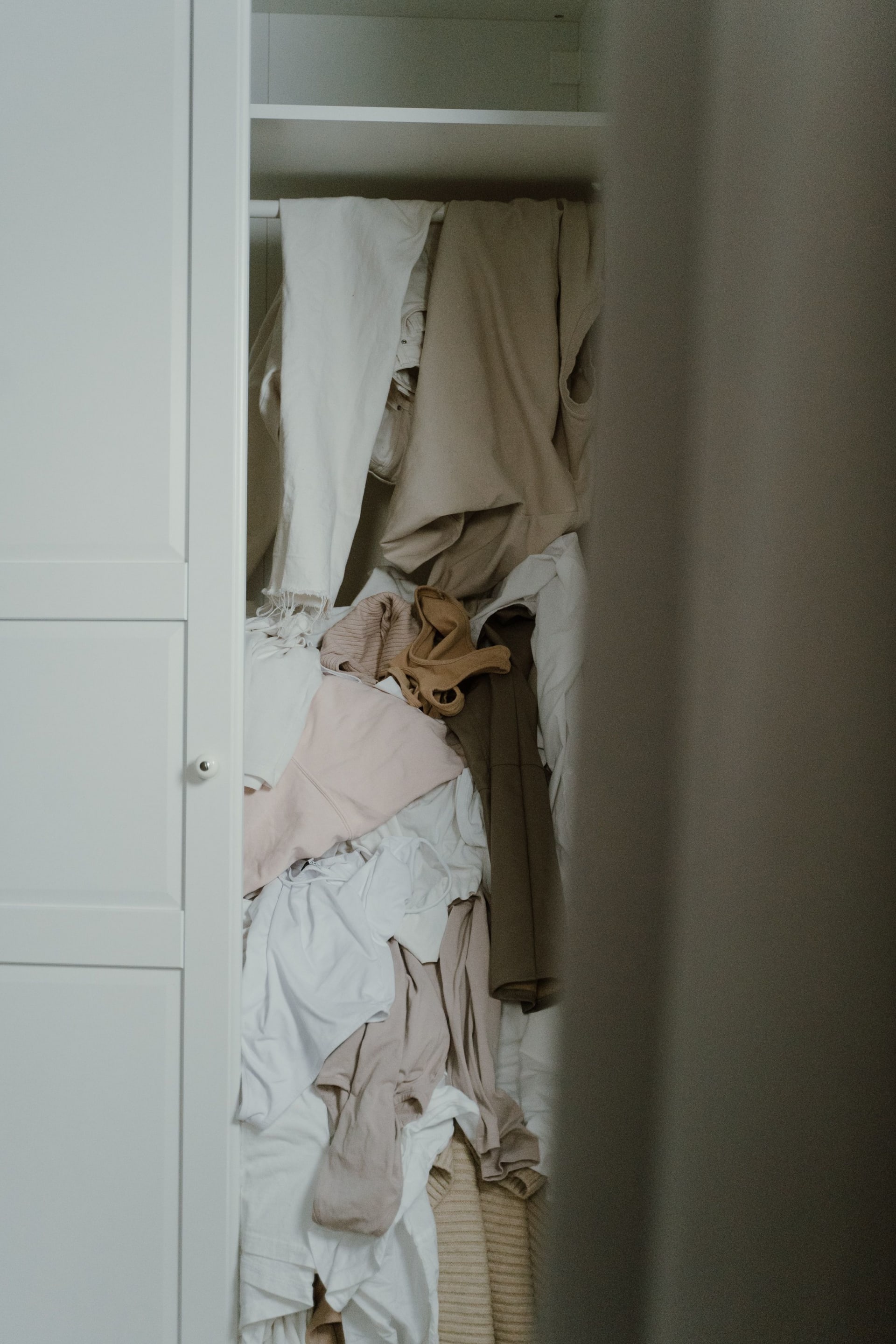
THE FAST FASHION PROBLEM IN ONE EQUATION
MATERIAL × VOLUME × LIFETIME × WASTE
Change the material, and you can reduce one part of the impact.
But if production keeps increasing, garments are worn fewer times, and huge quantities eventually become waste, the overall problem remains.
That's why the conversation cannot stop at:
"Is polyester bad?"
The more important question is:
"Why are we producing so much clothing, so quickly, for such a short life?"
Fashion doesn't need to stop being fashionable.
It needs to stop treating more as the only way to grow.
The future could mean fewer, better-made clothes. Longer product lives. Repair. Reuse. Rental. Resale. Circular systems instead of take–make–dispose.
Because you can buy better.
You can buy less.
You can wear something for ten years instead of ten weeks.
But don't confuse being a better consumer with fixing the fashion industry.
The biggest problem with fast fashion isn't that you bought one polyester sweater.
It's that the system was built to keep making more of them.

SOURCES & FURTHER READING
- Ghemawat, P. & Nueno, J. L. (2003). ZARA: Fast Fashion – Harvard Business School.
- Ellen MacArthur Foundation (2017). A New Textiles Economy: Redesigning Fashion's Future.
- Andreadakis, S. & Owusu-Wiredu, P. (2023). Fashion Footprint: How Clothes Are Destroying Our Planet.
- The OR Foundation. Kantamanto Market.
- Greenpeace (2021). Self-regulation: A Fashion Fairytale.
- McKinsey (2016). Style That's Sustainable: A New Fast-Fashion Formula.
- University of Pennsylvania. Fast Fashion.
Tags: fast fashion, trends, style, sustainability